📑 Quick Navigation
After completing your +2, you’re at a crossroads. College? A job? A skill-based course? If you’re a +2 student in Kerala, this guide breaks down every realistic path, what each one costs in time and money, and why some lead to a steady income far faster than most people expect.
The Reality Check
Every year, lakhs of students in Kerala finish Plus Two and most of them follow the same script: join a degree course because everyone else is doing it. For some, that is exactly the right choice. For many others, it means three or four years of fees, followed by a long search for a job that may not match what they studied.
Meanwhile, the demand for skilled technicians keeps growing. Almost everyone in Kerala owns a smartphone, many people own two, and every one of those phones eventually needs a screen, battery, charging port or board-level repair. Shops across Kochi, Thrissur, Kozhikode and Thiruvananthapuram regularly look for trained technicians and struggle to find people who can actually do the work.
So the real question is not “college or no college.” It is: which path fits your goals, your finances and how quickly you need to start earning?
Option 1: Traditional College (B.Com, BBA, B.Sc, BCA, Engineering)
A degree is the default choice in Kerala, and it has real strengths. It is required for government jobs, many corporate roles, higher studies and careers abroad that ask for formal qualifications.
When college makes sense
- You want a government job, a professional career (CA, law, medicine, engineering) or a postgraduate degree.
- Your family can support 3–5 years of study without pressure for you to earn.
- You genuinely enjoy academic subjects.
The trade-offs
- 3–4 years (or more) before your first salary.
- Fees, travel, hostel and material costs add up over several years.
- Many entry-level graduate jobs start at modest salaries, and competition is intense.
Option 2: Skill-Based Courses
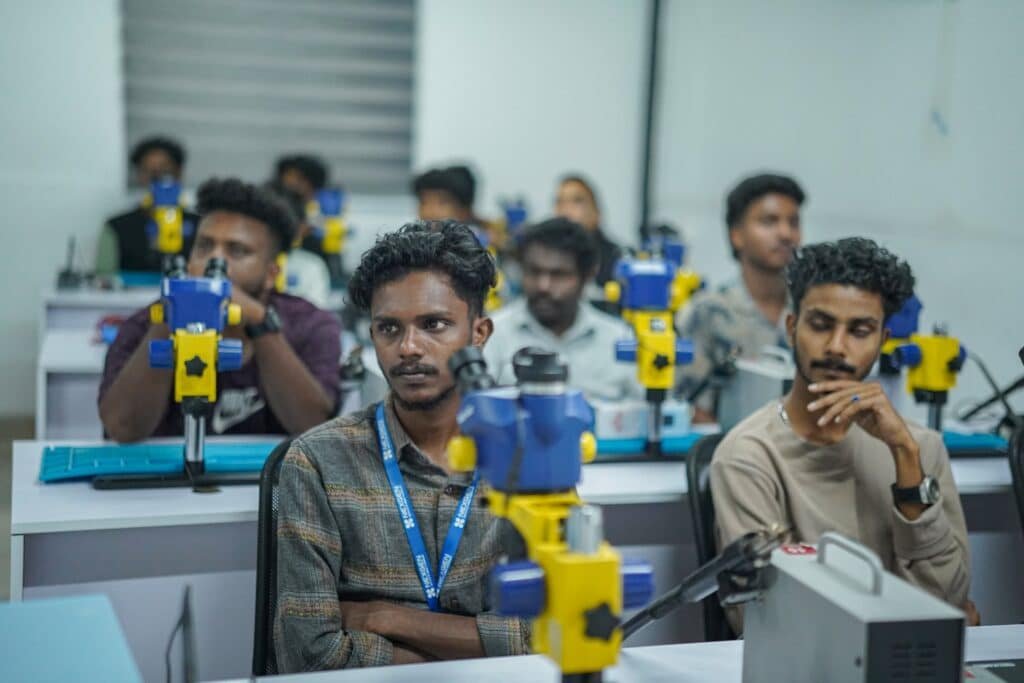
Skill-based courses focus on one thing: training you to do a job that people will pay for. They are short, practical and closely tied to what employers need. Popular options for +2 students in Kerala include mobile phone repair, digital marketing, graphic design, AC and refrigeration, electrical work and CCTV installation.
Among these, mobile repair stands out because demand is constant, the tools are affordable, and you can work in a shop, freelance, or eventually open your own service centre.
📱 Mobile Technician Course
- Short course duration (around 2–3 months)
- Screen, battery, charging port & software repairs
- Android and iPhone basics
- Job-ready for service centres and shops
- Typical starting salary: ₹18,000–₹25,000/month
🔬 Chip-Level Repair
- Advanced course (around 6 months)
- Board-level diagnosis and micro-soldering
- IC replacement, schematics and fault finding
- Fewer technicians, higher demand
- Experienced chip-level technicians can earn ₹50,000+/month
The biggest advantage of skill training is speed. Instead of waiting years, you can be earning within a few months of starting and keep learning on the job. Many students also continue a distance degree alongside work, so they get both income and a qualification.
Option 3: ITI Programs
Industrial Training Institutes offer government-recognised trades such as Electrician, Fitter, Electronics Mechanic and Mechanic Diesel. They are affordable, usually 1–2 years long, and lead to NCVT/SCVT certification.
- Good for: students who want a recognised trade certificate, apprenticeships, or jobs in industry, railways and PSUs.
- Keep in mind: seats are limited, admission is competitive, and the syllabus can be slower to reflect new technology like smartphones.
Decision Matrix: Compare Your Options
| Path | Speed to First Income | Earnings Potential | Cost | Best If |
|---|---|---|---|---|
| Traditional College | 3–5 years | Varies widely by field | High (several years of fees) | You want govt jobs, professional careers or higher studies |
| Mobile Technician Course | 2–3 months | ₹18k–₹25k start, ₹35k–₹50k with experience | Low–moderate | You want to earn quickly with a practical skill |
| Chip-Level Repair | ~6 months | ₹50k+ for skilled technicians | Moderate | You enjoy detailed technical work and want top pay |
| ITI Program | 1–2 years | Steady, industry-dependent | Low | You want a government-recognised trade certificate |
| Other Skill Courses | 3–12 months | Depends on skill and portfolio | Low–moderate | You have a clear interest (design, marketing, etc.) |
Salary figures are typical ranges in Kerala and vary with skill level, location and employer.
Why Mobile Repair Is the Smart Choice
If you want a career that starts fast and keeps growing, mobile technician courses are hard to beat. Here’s why:
- Demand that doesn’t stop: phones break every day, and new models bring new repair needs.
- Clear career ladder: start as a junior technician, move to senior technician, then specialise in chip-level repair certification or open your own shop.
- Low startup cost: a basic toolkit and a small counter space are enough to start freelancing.
- Works anywhere: the skill is valued in Kerala, across India, and in the Gulf.
- No long wait: you learn by doing, on real devices, from week one.
Typical progression: entry-level technicians often start around ₹18,000–₹25,000 per month. With a year of experience, ₹35,000–₹50,000 is common. Chip-level specialists can earn ₹50,000–₹80,000 or more, and technicians who build their own service business can earn well beyond that.
Real Career Paths
Here is what a typical path looks like for a +2 student who chooses mobile repair. (Illustrative example based on common career progressions.)
- Month 0: Joins mobile technician training
- Month 3: First job at a service centre, around ₹18,000/month
- Month 12: Senior technician, around ₹30,000+/month
- Month 18: Adds chip-level skills and freelance work, earning ₹50,000+/month
- Completes technician and chip-level training
- Works 1–2 years in a busy shop to learn customer handling
- Opens a small repair counter in their hometown
- Grows with accessories sales and repair contracts from local shops
The Kerala Advantage
Kerala has one of the highest smartphone usage rates in India, a dense network of mobile shops in every town, and a large Gulf-connected population that values technical skills. Kochi in particular has become a hub for mobile sales and service, which means more jobs, more practical exposure and more opportunities to start your own business.
How to Choose the Right Path
- Be honest about your goal. Government job or professional career? College is likely necessary. Want to earn soon? Look at skill training.
- Check your finances. Can your family support several years of study, or do you need income sooner?
- Test your interest. Do you enjoy working with your hands and solving technical problems? Visit an institute and try a demo class.
- Look at placement support. Ask how many students get jobs after the course and where they work.
- Think long term. You can always combine paths: work as a technician and study a distance degree at the same time.
Frequently Asked Questions
What are the best courses after +2 in Kerala?
Good options include mobile technician courses (around 2–3 months, with typical starting salaries of ₹18,000–₹25,000), chip-level repair (around 6 months, ₹50,000+ for skilled technicians), ITI programs, or a traditional degree. Mobile repair is one of the fastest routes to earning.
How much can a +2 student earn with mobile repair training?
Entry-level technicians typically earn ₹18,000–₹25,000/month. After about a year, ₹35,000–₹50,000/month is common. Chip-level specialists can earn ₹50,000–₹80,000+/month, and shop owners can earn more.
Should +2 students choose skill training over college?
It depends on your goals. Skill training gives faster earnings (within 3–6 months) at a lower cost. College is needed for government jobs, professional careers and higher studies, but takes longer. Both are valid, and many students combine them.
Ready to Choose Your Path?
The +2 students doing well right now aren’t the ones who picked college because “everyone does it.” They’re the ones who picked the path that fits them.
Confused? Let’s Talk
Not sure which path is right for you? Our career counsellors can help.