
iPhone CPU Reballing Course in Kochi: Master Advanced Double-Decker IC Repair Techniques
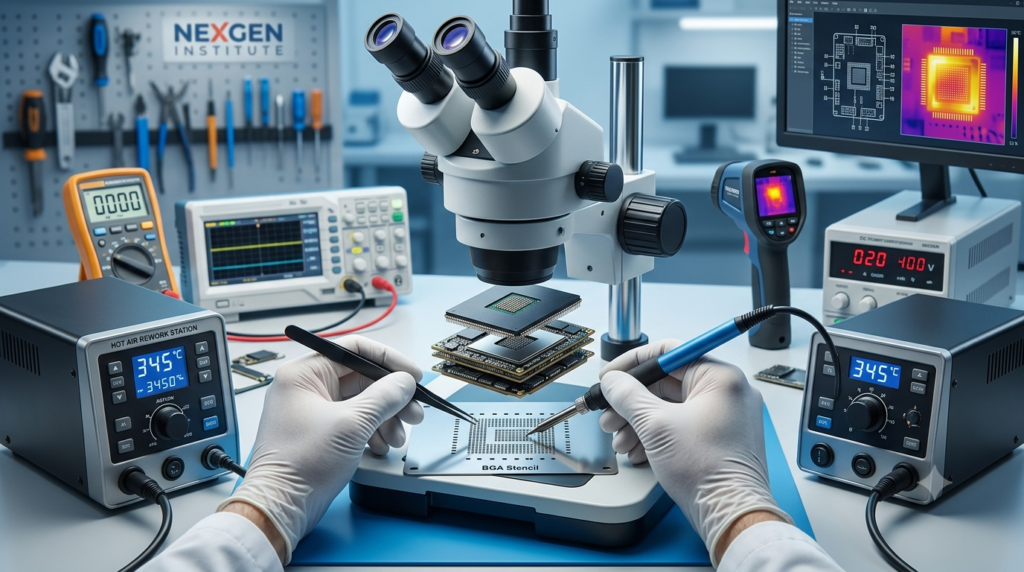
iPhone CPU Reballing Course in Kochi
The smartphone service industry has evolved rapidly over the last few years. Basic component replacement—such as swapping damaged screens, replacing batteries, or changing charging ports—is no longer a high-margin skill set. Premium flagship smartphones, particularly modern iPhones and high-end Android devices, utilize complex stacked motherboard architectures, low-temperature underfill glues, and tightly packed BGA (Ball Grid Array) integrated circuits.
For technicians seeking career growth and higher revenue, mastering advanced micro-soldering and double-decker CPU reballing is essential. Enrolling in a specialized iPhone CPU reballing course in Kochi provides the hands-on technical training required to diagnose dead logic boards, separate sandwiched PCBs, and safely reball multi-layer chips without damaging sensitive surrounding traces.
The Rising Demand for Advanced Chip-Level Repair Technicians in Kerala
With flagship smartphone prices continually increasing, consumers prefer repairing motherboard faults over purchasing new devices. However, most local repair shops lack the diagnostic tools, specialized equipment, and micro-soldering expertise needed to handle complex IC-level faults.
       TRADITIONAL REPAIR                    ADVANCED CHIP-LEVEL REPAIR
+--------------------------------+       +---------------------------------+
|  - Screen & Battery Swapping   |  ==>  |  - Double-Decker CPU Separation |
|  - Low Skill Barrier           |  ==>  |  - Micro-Soldering & Jumpering  |
|  - Low Profit Margins          |  ==>  |  - High Profit Margins / Value  |
+--------------------------------+       +---------------------------------+
Technicians trained in an advanced mobile repairing institute in Kerala gain a distinct competitive edge by offering high-value repair services that general service centers cannot perform:
Higher Revenue Per Repair: Logic board repairs yield significantly higher profit margins compared to standard part replacements.
B2B Service Opportunities: Specialized chip-level technicians often receive outsourced motherboard repair jobs from other retail service centers across Ernakulam and nearby districts.
Global Career Opportunities: Certified experts in BGA reballing and schematic analysis are in high demand across the GCC region and international markets.
Technical Deep-Dive: Understanding Double-Decker IC Architecture
Modern smartphone motherboards utilize PoP (Package-on-Package) technology, commonly referred to as “Double-Decker” IC architecture. In this design, the RAM chip is soldered directly on top of the main Application Processor (CPU) to save board space and maximize processing speeds.
+-------------------------------------------------------------+
|                     RAM Chip (Top Layer)                    |
+-------------------------------------------------------------+
|         BGA Solder Balls & Underfill Glue (Middle)          |
+-------------------------------------------------------------+
|                     Application Processor / CPU             |
+-------------------------------------------------------------+
|              Main Logic Board / PCB (Bottom)                |
+-------------------------------------------------------------+
Key Technical Challenges in CPU Repair:
Underfill Glue Removal: Manufacturer-applied epoxy underfill secures the IC to the PCB. Removing this glue requires exact heat profiles and specialized scraper blades to avoid peeling off delicate copper pads.
Thermal Management: Excessive heat during CPU desoldering can cause adjacent components, such as the Power Management IC (PMIC) or Wi-Fi module, to short circuit or drop connection balls.
Interposer Alignment: Dual-layer iPhone logic boards require precise middle-layer reballing platforms to ensure flawless connection across all power, data, and clock lines.
Step-by-Step CPU Reballing & Micro-Soldering Workflow
Professional micro-soldering requires a structured, step-by-step methodology to achieve high success rates on dead logic boards.
[Thermal & Schematic Diagnosis]
               │
               ▼
[Underfill Glue Softening & Clearing]
               │
               ▼
 [Controlled IC Lift & Pad Cleaning]
               │
               ▼
[BGA Stencil Alignment & Paste Application]
               │
               ▼
 [Microscopic Reflow & Board Testing]
Step 1: Diagnostic Isolation
Using a DC power supply, thermal imaging camera, and digital multimeter, the technician measures voltage rails and diode values to isolate the exact short circuit or open line on the board before touching the CPU.
Step 2: Underfill Softening & Precision Lifting
The board is placed on a pre-heating station set to a controlled temperature. Using a regulated hot-air rework station and precision tweezers, the technician gently removes the surrounding edge glue before lifting the CPU.
Step 3: Pad Cleaning & UV Solder Masking
Old solder and thermal residue are cleaned off the PCB using desoldering wick, high-grade flux, and isopropyl alcohol. Any exposed or damaged copper traces are repaired and insulated using UV-curable solder mask resin.
Step 4: Stencil Alignment & Reballing
A high-precision 3D steel stencil is aligned over the CPU. Medium-temperature solder paste (typically 183°C Leaded or 217°C Lead-Free, depending on the chip specifications) is applied evenly across the array. Heat is applied uniformly under a trinocular microscope until uniform solder spheres form.
Step 5: Final Reflow & Verification
The reballed CPU is repositioned on the PCB using alignment guides and reflowed into place. Post-repair testing confirms boot sequences, current draw stability, and full touch/display functionality.
Comparing Basic vs. Advanced Technician Capabilities
+----------------------------------+----------------------------------+----------------------------------+
| Skill Set                        | Basic Technician                 | Advanced Chip-Level Engineer     |
+----------------------------------+----------------------------------+----------------------------------+
| Diagnostic Capability            | Trial-and-error part swapping    | Schematic & bitmap line tracing  |
| Tool Mastery                     | Basic screwdrivers, heat gun     | Trinocular microscope, thermal   |
|                                  |                                  | camera, oscilloscope             |
| Repair Scope                     | Screens, batteries, charging ports| CPU reballing, PMIC replacement, |
|                                  |                                  | short circuit elimination        |
| Market Competition               | Very High (Saturated)            | Low (High barrier to entry)      |
| Average Earning Potential        | Moderate                         | Industry Leading                 |
+----------------------------------+----------------------------------+----------------------------------+
Practical Training at NexGen Institute Kochi
mastering micro-soldering requires structured hands-on guidance using professional-grade tools in an expert lab setting.
Students enrolling in specialized chip-level programs gain practical experience with real live dead boards, modern thermal imaging tools, and dedicated reballing stations. To explore structured course modules, lab infrastructure, and certification paths, visit the official NexGen Institute Course Details page. You can also discover practical troubleshooting guides, industry updates, and expert repair insights on the NexGen Institute Technical Blog.
Frequently Asked Questions (FAQ)
Q1: Is an engineering degree required to learn CPU reballing?
No formal engineering degree is required. Anyone with basic interest and dedication can master micro-soldering through structured, practical hands-on training that starts from foundational circuit concepts up to advanced IC reballing.
Q2: What essential tools are needed for a modern chip-level repair lab?
A standard advanced chip-level setup includes a Trinocular Microscope, temperature-controlled Hot Air Rework Station, precision Soldering Station, DC Power Supply, Thermal Camera, BGA Stencils, High-Purity Flux, and Solder Paste.
Q3: How long does it take to learn double-decker CPU reballing?
With intensive daily hands-on practice under expert instruction, students typically build strong technical confidence in interposer separation and BGA reballing within 2 to 3 months.
Q4: Does advanced chip-level training help in starting an independent service center?
Yes. Motherboard repair offers high profit margins due to minimal spare part costs. Advanced technicians can launch independent repair businesses or provide specialized sub-contracting repair services to other local shops.
Conclusion
The smartphone service sector is rapidly moving toward specialized board-level repair solutions. Technicians who invest in mastering double-decker CPU reballing, micro-soldering, and schematic diagnostic techniques position themselves for long-term career growth in 2026 and beyond.
By upgrading your technical capabilities through practical, lab-based training on live devices, you can transform from a standard technician into a highly sought-after motherboard specialist.