The Future of Micro-Soldering: Why Chip-Level Repair Skills Are in High Demand
Chip-level mobile repair career
The smartphone industry has evolved exponentially over the last decade. Today, we carry pocket-sized supercomputers capable of handling complex computing tasks, multi-lens photography, and high-speed connectivity. However, as smartphones become slimmer, more powerful, and increasingly expensive, their internal architectures have become highly intricate.
Gone are the days when a mobile technician could fix every issue by simply swapping a modular component or battery. Modern device troubleshooting requires digging deeper into the motherboard. This shift has created an unprecedented global demand for technicians specializing in micro-soldering and advanced diagnostics. If you are looking to build a future-proof technical profession, choosing a chip-level mobile repair career might just be your most lucrative option.
Understanding the Shift: Component Replacement vs. Chip-Level Repair
Traditional mobile repairing often restricted technicians to basic hardware updates, screen replacements, charging port swaps, and software flashing. While these basic skills are still necessary, they are no longer sufficient to survive in a highly competitive market.
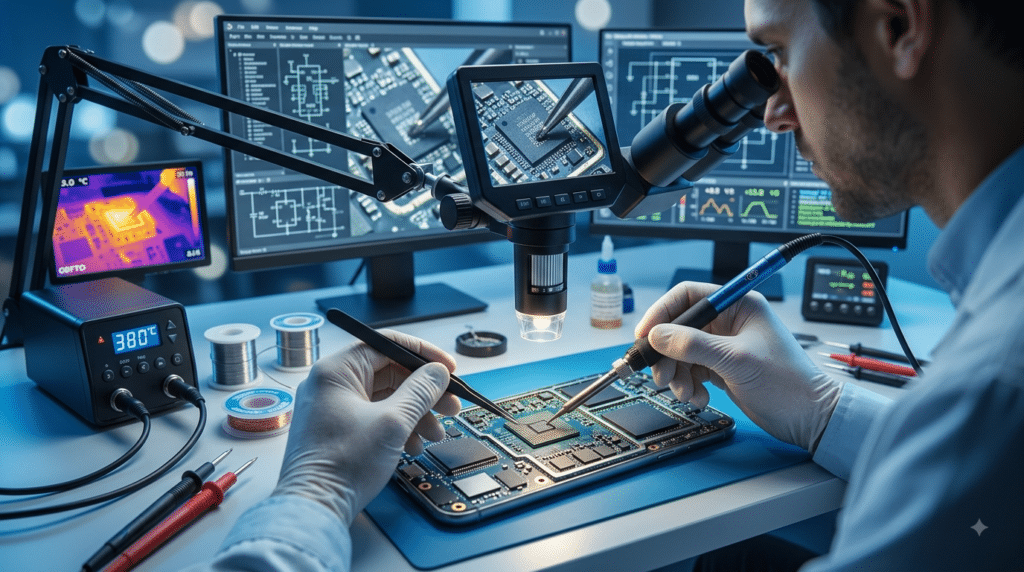
When a premium device like an iPhone or a high-end Android phone stops turning on, suffers from water damage, or develops complex logic board issues (such as audio IC failure or baseband errors), general service centers often declare the device “unrepairable.” This is where chip-level experts step in. By utilizing micro-soldering stations, thermal cameras, and digital microscopes, specialized technicians can isolate faults down to a single micro-capacitor, resistor, or Integrated Circuit (IC) and repair it without replacing the entire expensive motherboard.
Why Demand for Chip-Level Technicians is Skyrocketing
The Cost of Premium Smartphones: With flagship devices regularly crossing high price points, consumers prefer repairing their devices over buying new ones. A chip-level repair that fixes a dead motherboard for a fraction of the cost of a new phone provides immense value to customers.
The Rise of Micro-Soldering Ecosystems: Modern logic boards use Ball Grid Array (BGA) chips and microscopic Surface Mount Devices (SMD). Repairing these requires high-precision micro-soldering skills—a capability that cannot be automated by robots or handled by unskilled labor.
E-Waste Awareness and Sustainability: Repairing individual motherboard components extends the lifespan of devices, contributing to a reduction in electronic waste. Consumers and organizations are increasingly supporting the “Right to Repair” movement.
Career Opportunities and Global Scope
Mastering micro-soldering does not just qualify you to work in a local repair shop; it opens up multiple professional avenues worldwide:
Authorized Service Centers: Premium tech brands constantly look for certified chip-level experts to run their advanced diagnostic labs.
NexGen InstituteGlobal Employment Opportunities: There is a severe shortage of skilled micro-soldering technicians in the UAE, Middle East, and European markets, making it an excellent pathway for overseas employment.
Entrepreneurship: Setting up an advanced chip-level repair lab requires low initial capital compared to other businesses but yields exceptionally high profit margins because you are charging for specialized technical expertise.
How to Build a Successful Chip-Level Mobile Repair Career
Acquiring these high-level technical skills requires structured, practical, and mentor-led training rather than theoretical reading. To truly stand out in the industry, aspiring technicians must undergo training that covers:
Hands-on tracing of schematic diagrams and circuit board architecture.
Reballing and replacing complex BGA and IC components.
Advanced usage of diagnostic tools like DC Power Supplies, Oscilloscopes, and Multimeters.
For individuals seeking a verified pathway into this industry, enrolling in an industry-recognized program is critical. You can learn more about comprehensive programs by checking the structured modules on the Nexgen Institute Courses page, which bridges the gap between basic troubleshooting and complex logic board diagnostics.
Conclusion
The future of the smartphone service market belongs to those who understand what happens beneath the surface of a logic board. As technology advances, basic component swappers will face stagnation, while precision micro-soldering experts will continue to command premium service charges and high-paying jobs globally. Investing time in mastering chip-level repairs is a definitive way to build a rewarding, recession-proof tech career.
Frequently Asked Questions (FAQs)
Q1: What is the main difference between basic mobile repair and chip-level repair? A: Basic mobile repair involves replacing external parts like screens, batteries, camera modules, or charging strips. Chip-level repair involves working directly on the phone’s motherboard (logic board) to diagnose, micro-solder, and replace microscopic components like ICs, resistors, and capacitors.
Q2: Is a chip-level mobile repair career suitable for beginners with no electronics background? A: Yes, absolutely. Anyone can learn advanced chip-level repair provided they receive structured, step-by-step practical training starting from basic electronics up to advanced micro-soldering techniques under expert supervision.
Q3: Can I get job placement after completing an advanced mobile repair course? A: Yes, certified technicians are in high demand across authorized brand service centers, multi-brand repair outlets, and overseas tech hubs. Leading institutions like Nexgen Institute offer dedicated placement support to guide students into verified jobs or help them start their own business ventures.
Q4: How can I contact Nexgen Institute to learn more about the training programs? A: You can visit the official website at nexgeninstitute.in or get in touch directly via their official contact number at +91 9061882000 for detailed counseling regarding course batches, syllabus, and enrollment.