Mastering AI-Powered Smartphone Diagnostics & Firmware Flashing: A Comprehensive Guide for Next-Gen Repair Technicians
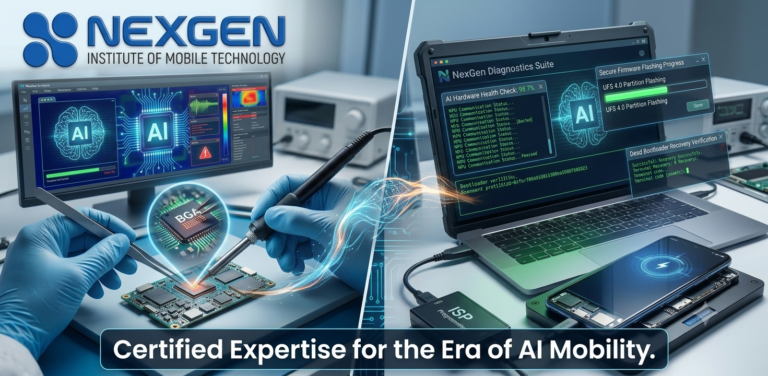
The mobile repair industry is undergoing a massive technological shift. With the integration of AI-powered processors (NPU/Neural Engine chips) in flagship Android and Apple devices, standard troubleshooting approaches are no longer sufficient. Today’s technicians must go beyond basic component replacement and master chip-level digital signal analysis, protocol decoding, and complex firmware flashing procedures.
Whether you are aiming to upgrade your technical skills or planning to enroll in a mobile repairing course in Kochi, understanding AI hardware diagnostics, dead-boot recovery, and secure firmware restoration will give you an unbeatable career edge.
1. The Shift to AI Hardware: Understanding Neural Processing Units (NPUs)
Modern mobile architectures combine the CPU, GPU, and NPU into a single System on Chip (SoC). When a device exhibits symptoms like high power consumption during AI tasks, camera processing lag, or sudden system lockups, traditional testing methods often fail.
Key Diagnostic Checkpoints for NPU-Enabled Devices:
System Rail Voltage Verification: Inspecting power delivery rails using high-speed digital storage oscilloscopes (DSO).
Thermal Throttling & Leakage: Identifying short circuits in auxiliary power lines using thermal imaging devices before performing micro-soldering.
I2C and SPI Bus Communication Lines: Checking communication integrity between the main SoC and dedicated sensor hubs.
For students undergoing smartphone chip-level training, hands-on lab access with multi-meters, oscilloscopes, and thermal cameras is essential to master these advanced diagnostics.
2. Advanced Firmware Flashing and Dead-Boot Recovery
Software issues in modern smartphones often manifest as hardware failures. A dead device showing no display might actually be trapped in Emergency Download Mode (EDL) or stuck in a Bootloader Loop due to corrupted flash memory partitions (UFS / eMMC).
[Diagnostic Process Flow]
1. Read Current Draw (DC Power Supply) ->
2. Detect Port Mode (EDL / DFU Mode) ->
3. Verify Flash Memory Health (UFS / eMMC) ->
4. Flash Stock Firmware / Patch Bootloader
Essential Steps in Advanced Firmware Restoration:
Entering Deep Hardware Flashing Modes: Knowing how to invoke Qualcomm EDL mode using test points or test cables, and Apple DFU (Device Firmware Update) mode.
UFS / eMMC ISP Pinout Direct Flashing: When USB communication fails, connection directly to the board’s In-System Programming (ISP) points allows reading and writing system partitions directly.
IMEI & Security NVRAM Backup: Ensuring network parameters and cryptographic keys are safely preserved prior to full partition wiping.
Mastering these procedures opens lucrative service opportunities, especially for high-end Android smartphones and iPhones.
3. Resolving Chip-Level Power Management and Logic Board Faults
Firmware corruption and processor instability are frequently caused by improper power delivery. When a device drops into an infinite restart loop after an over-the-air (OTA) system update, inspecting the Power Management IC (PMIC) is critical.
Common Power Delivery Failures:
Buck Converter Capacitor Shorting: Causes immediate thermal shutdown during high-load processing.
Corrupted EEPROM Data: Prevents the CPU from executing initial boot code.
Damaged USB PD (Power Delivery) Control IC: Leads to slow charging, fake charging, or total boot failure.
Learning step-by-step logic board diagnosis under expert mentorship at an accredited institute ensures you can diagnose complex board-level issues with zero trial-and-error.
4. Career Opportunities & Market Demand in Kerala
As smartphones become more complex, service centers face an acute shortage of certified, skilled chip-level technicians. Individuals who possess dual expertise in both hardware micro-soldering and advanced firmware programming command premium salaries and business revenue.
If you are considering a career transformation, choosing an institute that provides NSDC & STED Council certified courses ensures your qualifications are officially recognized by employers across India and abroad. Furthermore, if your vision is to establish your own repair brand, robust business mentorship and technical placement support are essential launching pads.
Conclusion
The smartphone service landscape is moving rapidly toward specialized hardware-software interplay. Technicians who continuously upskill in AI diagnostics, UFS programming, and chip-level logic board recovery will dominate the market. Investing in professional, practical hands-on training is the single best step you can take toward securing a long-term, high-income career in mobile technology.
Frequently Asked Questions (FAQ)
Q1: Is software flashing knowledge necessary for a chip-level hardware technician?
Yes. Modern mobile failures frequently blur the line between hardware and software. Understanding firmware flashing, EDL mode, and bootloader recovery prevents misdiagnosing software corruption as a permanent hardware failure.
Q2: What tools are required for advanced smartphone firmware recovery?
Professional technicians use specialized software tools, direct ISP programming hardware boxes, USB testers, digital storage oscilloscopes, and DC power supplies to safely flash and recover dead devices.
Q3: How long does it take to learn chip-level repair and firmware flashing?
At NexGen Institute of Mobile Technology, hands-on diploma courses range from 4 months to 8 months, giving students complete practical knowledge in smartphone hardware, iPhone repair, micro-soldering, and firmware diagnostics.
Q4: Can I open my own mobile repair center after completing this course?
Yes. Comprehensive training programs at NexGen include practical lab sessions, business development support, inventory setup guidance, and ongoing career mentoring to help you launch a successful mobile repair business.
Contact Details
NexGen Institute of Mobile Technology
Address: Second floor, NKM Arcade, Ponnurunni, Vyttila, Kochi, Ernakulam, Kerala 682019
Phone / WhatsApp: +91 90618 82000
Email: nexgeninstitutecochin@gmail.com
Website: https://nexgeninstitute.in/
Operating Hours: Monday – Saturday, 9:30 AM – 6:00 PM